
Cook County Same-Day Release Gap
The Cook County Sheriff provides a stable Jail Roster landing page. When the research was checked, that page linked one dated PDF. It did not include a tab or link for released inmates, a last-day list, or a booking archive. The page also gave no refresh schedule and no promise that older files remain available. A Cook County 24-hour release search must begin with that limitation.
A person who disappears between two roster reports did leave that snapshot, but the reason is still unknown. Cook County operates a small local holding facility and sends some longer-term detainees to other counties. Other possible movements include bond, court release, time served, state DOC commitment, a hospital move, or another agency’s hold. Treat roster absence as a clue. The Sheriff custody-event record identifies what actually happened.
Check Cook County 24-Hour Releases
Start with a full legal name, spelling variants, an approximate booking date, and a court file number if known. Match more than a name. A report time, court event, and agency response form a much stronger same-day record than an isolated screenshot. For a broader named-person search beyond today, the Cook County released inmates lookup connects the county, state, and federal paths.
- Open the official jail roster landing page. Record the linked PDF’s report date and time before checking for the person.
- Search that one person through Minnesota VINE. Read the custody wording and the agency that supplied the event.
- Call the Cook County Law Enforcement Center at 218-387-3030. Ask whether Cook County released the person to the community or transferred custody.
- Review the newest Cook County case entry in Minnesota Court Records Online for a bond order, release order, sentence, warrant, or disposition.
- If staff cannot give enough detail by phone, request the booking sheet and custody, movement, and release entries under Minnesota chapter 13.
- When a transfer is confirmed, continue with the named receiving jail, Minnesota DOC Locator, BOP, or ICE system as the destination requires.
The order matters. The current roster answers whether a person appeared at one report time. VINE may show an agency-reported custody change. A court order explains the legal basis, while the custodian’s timestamped event log proves the physical movement. These records can describe different parts of the same day without contradicting one another.
Minnesota Court Records Online can show charges, hearings, disposition, sentencing, warrants, and some case documents. Its newest entry can explain why custody was expected to change, but it may not show the minute when jail staff completed processing. Match the court file to the booking and retain both records. If Cook County moved the person to a contract jail, the case may still appear in the Sixth Judicial District while the physical custodian is elsewhere.
Note: Save the roster report time because the landing page does not publish a refresh cadence or a historical retention period.
Cook County Release Fields to Request
Because no official Cook County same-day release table exists, its public fields are not “blank” or “zero.” They are not published as a feed. Ask Sheriff Records for existing fields that establish the local custody event. A narrow request is easier to process than a question that asks staff to create a new report.
| Field | What it can establish |
|---|---|
| Booking number and identity | Connects the release or movement entry to the correct Cook County booking. |
| Booking date and time | Sets the start of the local custody period and helps narrow the request. |
| Charge, hold, and court file | Links the booking to the court case and any other agency hold. |
| Custody exit date and time | Shows when Cook County physically relinquished custody. |
| Release or movement code | Distinguishes bond, court order, time served, transfer, or another recorded event. |
| Receiving agency or destination | Shows whether another jail, DOC, or other authority took custody, when public. |
Some data can be withheld or redacted. Active investigations, juvenile matters, sealed or expunged files, safety data, and other protected classifications affect access. If the public response omits a field, ask which data classification applies rather than guessing from the current roster.
Sheriff Records accepts requests in person, by phone, mail, email, or through the county’s online public-data form. Describe existing records and a date range. A useful request asks for the booking sheet, timestamped custody-event log, release or movement code, destination, and receiving agency. It should not ask staff to decide whether a person was “really free,” since that conclusion may require several records.
Cook County Release or Transfer
Cook County Jail is licensed as a secure coed 72 Hour Holding facility. The county also describes local first-appearance and pretrial holding, along with a separate Work Release/Huber function. People needing longer pretrial confinement, and some sentenced people who cannot use work release, may be housed in other counties. The official county page does not name one fixed receiving jail.
That model makes destination more useful than a simple yes-or-no answer. “Released from Cook County” can mean freedom in the community, but it can also mean Cook County handed the person to a receiving county, the Minnesota Department of Corrections, or another custodian. A work-release participant may also be outside for an authorized shift while still legally confined. Ask for the movement code and receiving agency.
- Release
- The holding agency ends physical custody, though supervision or another legal duty may continue.
- Transfer
- One agency gives physical custody to another. The person remains confined.
- Supervised release
- A state prisoner leaves prison but remains under Minnesota DOC jurisdiction.
- Discharge
- The controlling sentence or supervision ends. It is not the same as leaving a jail building.
Cook County Release Time Facts
Cook County publishes no fixed release-processing hour, weekend discharge rule, public exit door, or family waiting location. The jail’s official wording about “72 hours excluding weekends and holidays” concerns how long certain first-appearance and pretrial detainees may be held locally. It does not announce when releases occur. Turning that holding rule into a release timetable would create a false promise.
Call the Law Enforcement Center for person-specific instructions. Confirm whether a release order has reached the jail, whether another hold remains, which facility is processing the exit, and where a safe pickup can occur. Do not wait in a secure law-enforcement area without staff direction. Court timing and jail processing are distinct, so an order filed today does not establish an exact door-out time.
Note: The Cook County holding limit and an online 72-hour release list are unrelated concepts, despite their similar wording.
Getting Home After Cook County Release
Arrowhead Transit publishes Cook County service information, but neither the transit service nor the Sheriff promises a pickup timed to a release. Cook County’s geography makes this more than a minor detail. A transfer may place the person at a receiving jail far from Grand Marais, so travel plans made before the actual releasing facility is known may point to the wrong town.
First confirm the custodian and exit location. Then check current transit service, pickup points, reservation needs, and operating times directly with the provider. Family or friends should get facility instructions before driving. No official Sheriff source promises a ride, a family waiting zone, or a fixed public release door.
Cook County Roster Snapshot Limits
The official roster uses a Document Center with one dated PDF, not an interactive history. Its design creates an archival gap. A saved PDF can show that a person appeared at its report time. It cannot prove when the name was removed, why it was removed, or where the person went. Comparing two PDFs may narrow a time interval, but it does not create an official release list.
The official roster view below shows the county’s stable landing page rather than a hard-coded dated file. Visit the Cook County Jail Roster source for the current document.
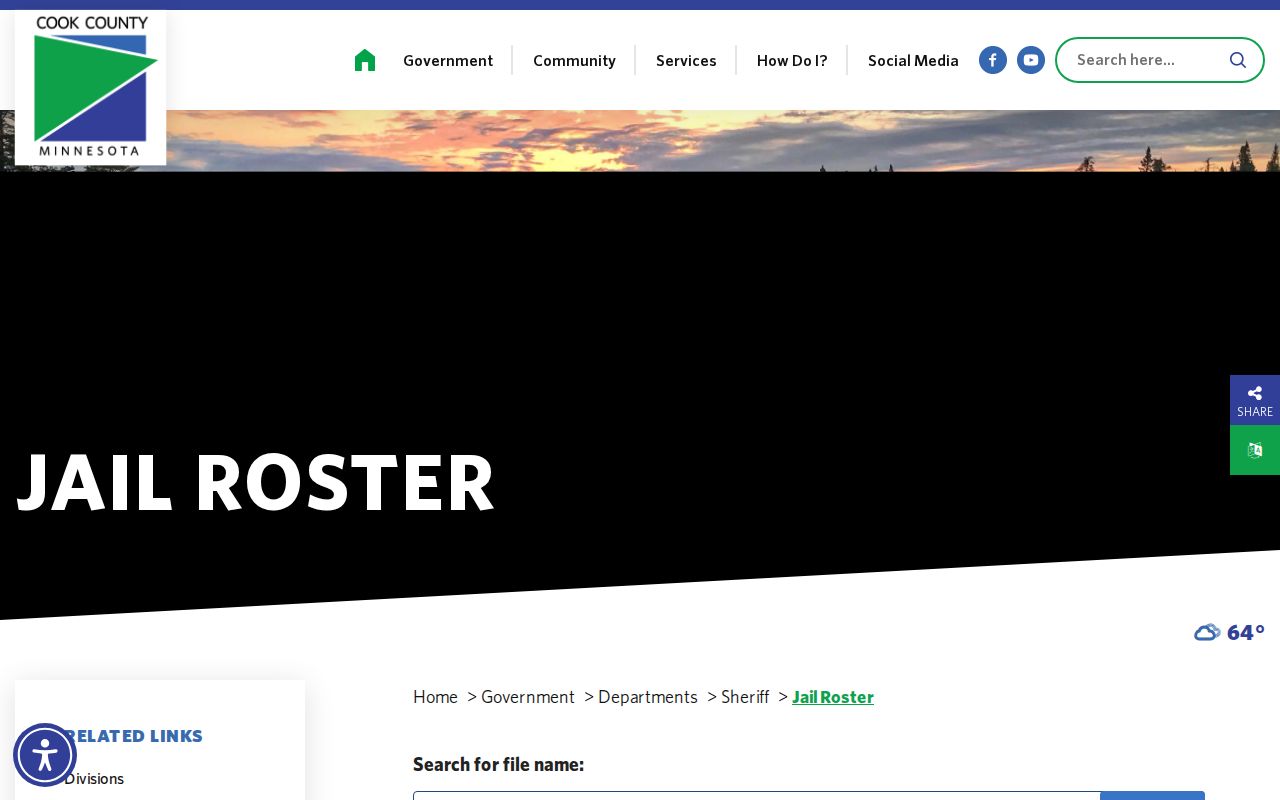
The screenshot reinforces the key limit: the county presents a current dated roster document, not a last-24-hours release feed or public archive.
Cook County Mobile Release Channels
No Cook County Sheriff jail-information or recent-booking app was found in the county’s official resources. The Sheriff links an official Facebook page, but no systematic release series was identified there. Social posts can add context to an event, yet they cannot confirm current custody or a same-day release.
Minnesota VINE offers mobile access for person-specific searches and custody alerts. It is a statewide notification tool, not a Cook County booking archive and not a complete list of everyone released today. Search the correct person, verify identity and reporting agency, then confirm the event with the Sheriff’s custody log.
Note: For a wider date span, the Cook County 72-hour release list process uses the same official records with a multi-day review.
Public Record Search
Sponsored Results