
Cook County Release Meanings
A Cook County release is a custody event, not one universal document. The Cook County Sheriff may record a community release after bond, a court order, time served, or completion of a short sentence. The same movement log may instead record transport to another county jail, delivery to the Minnesota Department of Corrections, or transfer to another authority. Each outcome removes a name from the local roster, but only the first group clearly means the person returned to the community.
The local detention model makes that distinction vital. The Cook County Law Enforcement Center is licensed as a 72 Hour Holding facility. Longer pretrial stays and some local sentences are served in other counties, while a person committed to the Commissioner of Corrections moves into the state system. “Released” can thus mean released by Cook County to another custodian. Ask who received the person.
- Release
- The custodian gives up physical control, either to the community or another authority.
- Transfer
- Custody continues with a different jail, prison, court transport, or agency.
- Supervised release
- A state prisoner leaves prison but remains under Minnesota DOC jurisdiction.
- Final discharge
- The sentence or correctional jurisdiction has ended, which is later than physical prison release in many cases.
Cook County Inmate Release Paths
The legal basis and the destination belong together. A court order may authorize an exit, while the jail record supplies the actual processing time and receiving party. Cook County released inmate records should be read with both sources when the difference matters.
| Event | What it means | Where to verify next |
|---|---|---|
| Bond or court release | The person may leave local custody under stated conditions. | Sheriff custody log and Cook County court case |
| Time served or sentence completion | The local custodial term may be complete. | Sentencing order and releasing jail record |
| Huber or STS completion | The work-release sentence ends, rather than a routine work pass. | Cook County custody record and sentencing order |
| Contract-jail transfer | The Cook County case continues while another sheriff holds the person. | Cook movement record, receiving jail, and Minnesota VINE |
| State commitment | The person enters Minnesota DOC custody after an executed felony sentence. | MNDOC Locator after intake and the court judgment |
| Federal or immigration transfer | Another authority may keep the person confined. | BOP, USMS, ICE, and the named custodian |
Hospital transport, a warrant from another county, escape, and death may also end a local roster entry. None should be relabeled as an ordinary community release. The agency’s own disposition term controls.
Cook County Release Record Fields
A useful request seeks existing booking and movement data instead of asking staff to create a narrative. The Sheriff may hold the clearest proof of when Cook County relinquished physical custody and whether another agency took over. Public access can still be limited by active-investigation rules, juvenile protections, sealed or expunged matters, medical data, security concerns, and other classifications.
| Field | What it can establish |
|---|---|
| Legal name and identifiers | Which person the Cook County booking concerns |
| Booking number and time | The local custody episode tied to the release entry |
| Charge or hold summary | The stated basis for detention, subject to later court action |
| Release or movement time | When Cook County processed the physical custody change |
| Disposition or event code | Whether the event was bond, court release, completion, or transfer |
| Release authority | The order, sentence, or other authority recorded by the custodian |
| Recipient or destination | The next agency or community destination when public |
A charge is an allegation unless adjudicated. Likewise, a booking proves processing into custody, not guilt. The release entry answers a custody question and may not explain the full court result.
Request Cook County Release Records
Cook County Sheriff Records accepts requests in person, by phone, mail, email, and through the county’s online form. The evergreen routes are the Sheriff Records page and the Cook County Public Data Request form. Identify the person, approximate date range, and the booking if known.
- Ask for the booking sheet, custody or movement log, and the date and time Cook County relinquished custody.
- Request the release or movement code, legal authority for the event if maintained, and receiving agency or destination for any transfer.
- State that the request seeks existing public data and electronic copies in the format maintained by the county.
- Ask the county to cite the statute for any redaction or denial and to provide segregable public portions.
- Use the booking number and a narrow date range if staff needs help locating the event.
143 Gunflint Trail
Grand Marais, MN 55604
Phone: 218-387-3030
Fax: 218-387-3032
Inspection is free. Cook County states that no copy charge applies when cost is under $10. For no more than 100 letter or legal black-and-white pages, the published rate is 25 cents per one-sided page or 50 cents per two-sided page. Other copies may carry actual costs, and prepayment may be required. Ordinary records are provided as soon as reasonably possible, with no fixed-day promise.
The official Sheriff records channel appears in this captured view.
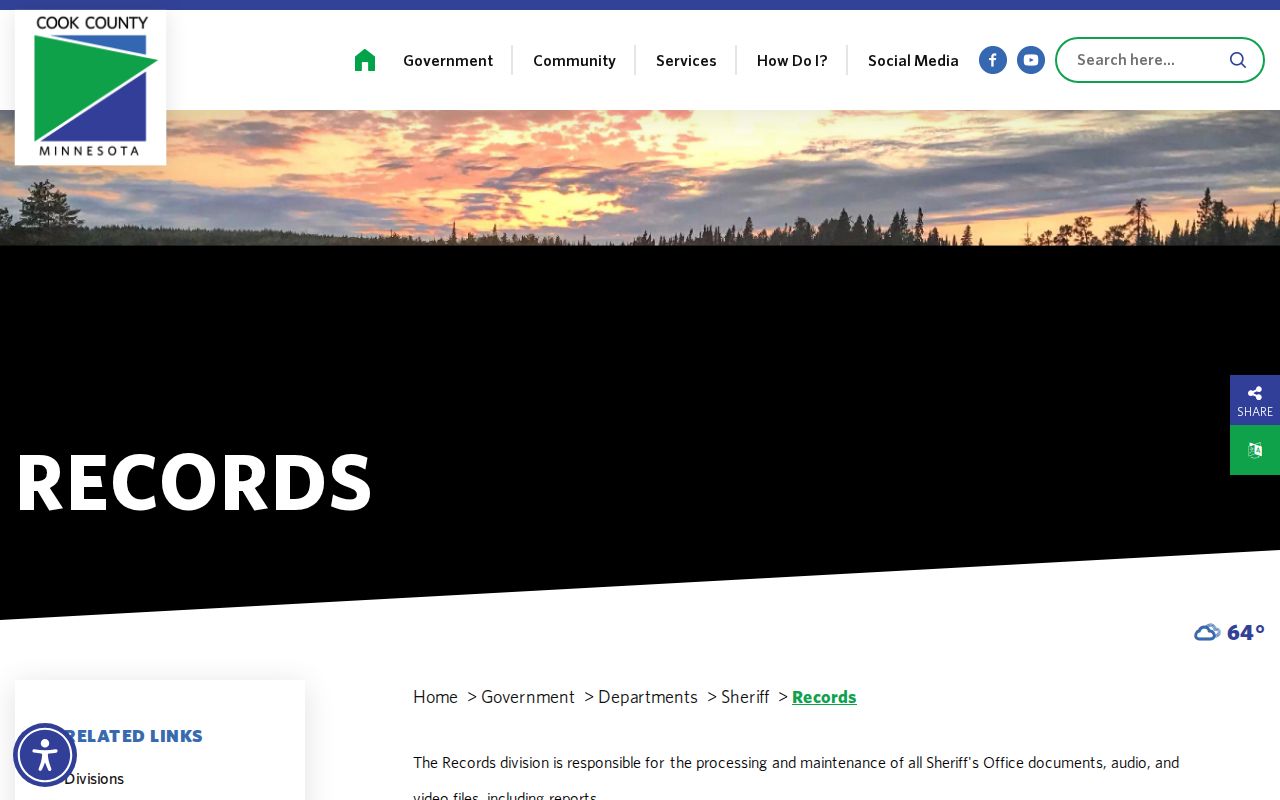
The page supports several request methods, which helps when the current roster no longer contains the person.
Cook County Release Data Law
Minnesota’s Government Data Practices Act controls access. Minnesota Statutes section 13.03 establishes public-data access and copy rules, while section 13.025 requires each government entity to publish its access procedure. Law-enforcement data classifications appear in section 13.82. Corrections records require a separate section 13.85 analysis because government possession does not make every field public.
Ask for public portions and a statutory reason for withheld data; do not assume the full jail or DOC file is open.
Expungement under Minnesota chapter 609A can seal records held by agencies named in an order. It does not guarantee that each old copy, news item, tribal record, or federal record disappears. A sealed case may no longer appear in Minnesota Court Records Online. That absence alone does not prove no case ever existed.
Cook County Release Property Records
The public jail page does not publish a property-return checklist. Minnesota DOC’s jail inspection confirms that local policy must address property control and release, but that general requirement does not reveal what happened in one booking. A Cook County released inmate who disputes missing property can request the signed property acknowledgment, inventory, and related release transaction from Sheriff Records.
An inaccurate release code can also be addressed through the government office that maintains the data. The Cook County Data Practices Policy identifies a responsible-authority process for public information. Supply the booking and explain the exact field believed to be wrong. A request for correction differs from a request that the county create a new explanation.
Note: Property paperwork can support a release inquiry, but the custody-event timestamp remains the key proof of the actual exit or transfer.
Find Cook County Released Inmates
Start with the correct identity and custody layer. Gather the legal name, likely spelling variants, approximate booking date, and court case number. Determine whether the person was held only by Cook County, transported to another county, sentenced to state prison, involved in a federal case, or potentially transferred to immigration custody. A common name alone is not enough.
- Open the stable Cook County Jail Roster landing page and note the dated PDF’s report time. Treat it only as a current snapshot.
- If the name is gone, call 218-387-3030 and ask whether Cook County released the person to the community or transferred custody to a named agency.
- Search Minnesota VINE for the specific person and read both the status and supplying facility. A VINE release can still describe release to another custodian.
- Search the Cook County case in Minnesota Court Records Online for the newest bail, release, sentencing, warrant, or disposition entry.
- If transferred, continue with the named receiving jail. If committed to DOC, search by name and then preserve the six-digit MNDOC Offender ID.
- Request the Sheriff’s custody-event log when the online snapshot cannot answer the date, reason, or destination.
A person normally drops off the live roster after Cook County gives up custody. Roster absence is a clue, not proof of community release.
The wider system-by-system path is also reflected in the Cook County parole and probation page, while local custody details begin with the Cook County Jail release page.
Cook County DOC Release Search
The Minnesota DOC Locator covers adults committed to the Commissioner who remain under DOC jurisdiction. That includes people in prison and people physically released from prison who are still on supervision. It is not the right database for a person who spent only a short period in Cook County Jail and was never committed to DOC.
| Search field | How it works | Use |
|---|---|---|
| First name | Begins-with matching is available | Use with surname and verify the result |
| Last name | May return conviction names and name history | Try lawful variants or prior names |
| MNDOC Offender ID | Numeric six-digit identifier | Best repeat-search key |
| Detail labels | Status, facility or supervising location, sentence, and available dates | Copy the interface’s exact wording |
Do not rename an expiration, eligibility, sentence, or supervision date as a release date. If an exact projected date is displayed, it is still an estimate. When the public result lacks the needed field, DOC Records Management can respond about public commitment, release, supervision, and final-discharge data tied to the OID.
The official DOC search interface is shown in this captured image.
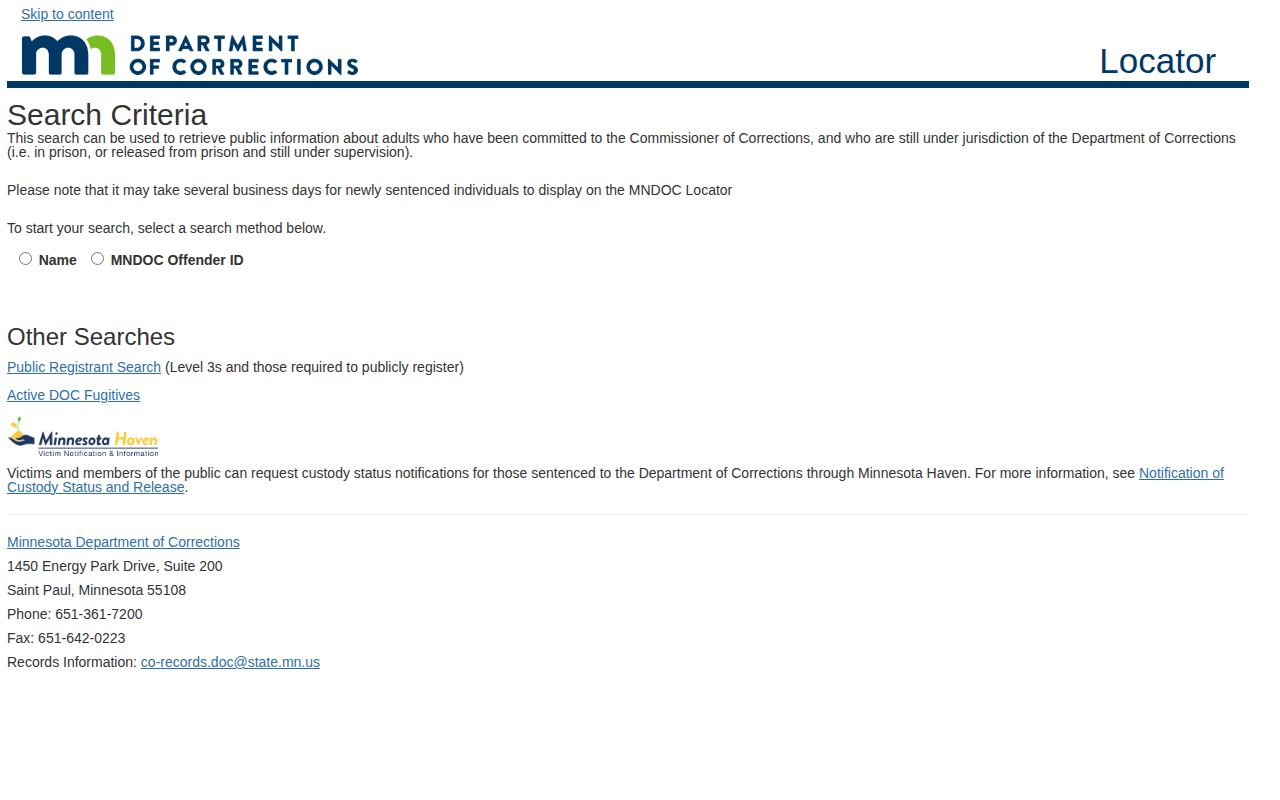
The name and OID routes shown here serve state cases, not the Cook County current-jail roster.
Cook County Release Roster Gap
Cook County publishes one dated roster PDF through a Document Center. The official landing page offers no labeled 24-hour, 48-hour, or 72-hour released-person view. It also states no refresh time, retention period, or archive promise. Comparing two PDF snapshots can suggest a change, but it cannot identify the movement code or destination.
The practical check uses three sources: the timestamped roster snapshot, a specific-person Minnesota VINE result or alert, and the Sheriff’s custody-event record. Add the court case when the reason for release matters. If Cook County names a receiving jail, verify the person with that custodian. Never turn a scraped difference between PDFs into an official release list.
Does “72 Hour Holding” mean a 72-hour release list? No. It describes Cook County Jail’s licensed holding function and the stated local limit for certain first-appearance and pretrial detainees. It is not a public list window.
Cook County Inmate Release Times
Cook County publishes no fixed release-processing time, weekend discharge schedule, exit door, or family waiting location. The jail’s “72 hours excluding weekends and holidays” wording concerns how long certain detainees may be held locally. It does not promise when an individual will walk out.
Call the Law Enforcement Center for person-specific instructions. Ask whether the planned event is a community exit or a transport and whether the time is firm. Avoid waiting in secure law-enforcement areas. Court action, another hold, transport availability, or final paperwork can change an expected movement.
Note: A stated plan is not final proof; the Cook County release log supplies the processed time after the custody event occurs.
Getting Home After Cook Release
Transportation planning begins only after the releasing facility is confirmed. Cook County may send a person to another county for a longer stay, so the eventual exit may occur far from Grand Marais. Arrowhead Transit publishes Cook County service information, but neither the transit provider nor the Sheriff promises a ride aligned with a release.
Confirm the actual custodian, exit location, expected time, and any property instructions before arranging travel. A court case may still be captioned Cook County even when another sheriff controls the person’s physical release. That split is common enough here to make destination confirmation the first logistics task.
Cook County Release Court Records
Cook County cases remain in Minnesota’s Sixth Judicial District even when another county houses the defendant. The person may return to Grand Marais or appear by video from the receiving jail. Case county and custody county can therefore diverge without any error in the records.
Use Minnesota Court Records Online to find the case and review bail or release orders, disposition, sentencing, warrants, and amended entries. A judge’s order explains legal authority. The custodian’s event log proves the physical movement. One source should not be forced to answer the other source’s question.
Can a release order prove the exact exit time? Usually not. Another case, warrant, transfer, or processing step may delay community release after the court acts.
Cook County Post-Release Status
Probation follows a court sentence and may occur without any state-prison term. Supervised release follows the prison part of many modern Minnesota felony sentences. A person released before trial may instead face court-ordered conditions, which are neither probation nor DOC supervised release. Verify the legal label in the sentencing or release order.
Minnesota VINE is the county-jail notification layer. It can report release, transfer, escape, and death events from a supplying agency. Minnesota Haven serves Commissioner-sentenced DOC cases and provides a different set of notices, including release and agent-assignment information through its stated channels. Federal BOP and ICE searches apply only when those systems actually held the person.
Final discharge can remove a person from the DOC Locator’s active-jurisdiction scope. For an older Cook County release, the court case and a narrow records request are more durable than a live custody database.
Cook County Release Search Sources
Each official system has a narrow role. Use the system that created the record, then reconcile it with the court or receiving custodian when the event crosses jurisdictions.
| Person or event | Best source | Main limit |
|---|---|---|
| Currently listed local detainee | Cook County dated roster PDF | Current snapshot, not release history |
| Past local release or transfer | Sheriff custody or movement record | Protected fields may be withheld |
| State prisoner or released person under DOC jurisdiction | MNDOC Locator and DOC Records | Not for jail-only custody; final discharge may end locator visibility |
| Legal reason for release | Cook County court case | May not show the physical exit time |
| Federal sentence | BOP Inmate Locator | Does not rule out another hold |
| Possible immigration transfer | ICE Online Detainee Locator | A recent transfer or protected case may not appear |
Cook County Release Facilities
Cook County’s release map includes one local adult detention center and several custody pathways rather than seven physical buildings in the county. The Huber unit sits inside the Law Enforcement Center. Contract housing is unnamed until a person-specific movement record identifies the receiving jail. State, federal, and immigration custody occurs through facilities outside the county, while Grand Portage cases require identification of the actual arresting and custodial authority.
- Cook County Jail / Law Enforcement Center: short local holding, work release, release, or transfer.
- Cook County Work Release/Huber Unit: authorized work movement differs from final discharge.
- Contract/Receiving County Jails: another sheriff holds longer-stay detainees when assigned.
- Minnesota State Correctional Facilities: MNDOC custody and released-but-supervised records.
- Federal Bureau of Prisons Facilities: federal sentence and release-date records.
- ICE Detention Network: immigration custody after a possible criminal-custody transfer.
- Grand Portage Custody Pathway: agency and jurisdiction must be identified first.
The location of the criminal case does not prove the location of confinement. Cook County released inmate verification follows the custodian that actually processed the last movement.