
Cook County Projected Versus Actual
A projected date is a current calculation, not proof that someone walked out. For a sentenced person, it may reflect the executed term, jail credit, consecutive or concurrent sentences, credit rules, discipline, and the law tied to the offense and sentence date. An actual release is a completed custody event recorded by the agency that held the person. The two can match, but one should never be relabeled as the other.
A Cook County pretrial detainee does not have a sentence-based release date. Bond, a release order, dismissal, another hold, or transfer can change custody. The county roster is only a dated snapshot. A person can leave it while still confined in a receiving county jail, in DOC custody, or under another authority.
For a local sentence, the Sheriff or receiving jail maintains the custody calculation. For a state-prison sentence, MNDOC applies the controlling statutes and sentence data. The court judgment is vital, yet it may not show later credit decisions, discipline, release-plan approval, or a new detainer.
Find Cook County Projected Release Dates
Begin by deciding whether Cook County, another county, or MNDOC is the current custodian. Cook County is a short-term holding facility and sends many longer stays to other counties. A Cook County case can remain in Grand Marais while the physical sentence calculation sits with another jail.
- Open the Cook County case in Minnesota Court Records Online. Record the sentence, start date, jail credit, stayed or executed status, and whether terms run together or one after another.
- Call Cook County Jail at 218-387-3030 to identify the current custodian. If the person moved, ask for the receiving agency and the time Cook relinquished custody.
- For a state commitment, search the MNDOC Locator by name or six-digit OID. Copy each date label exactly and do not assume every result displays a projected date.
- If the date is not public, request the local calculation from the jail or public sentence and release data from MNDOC Records Management.
- Near the expected date, confirm the live status with the custodian and an official alert. A record made after the event is stronger proof than the earlier estimate.
The official MNDOC Locator source shows the name and OID search route used for a Cook County state-prison sentence.
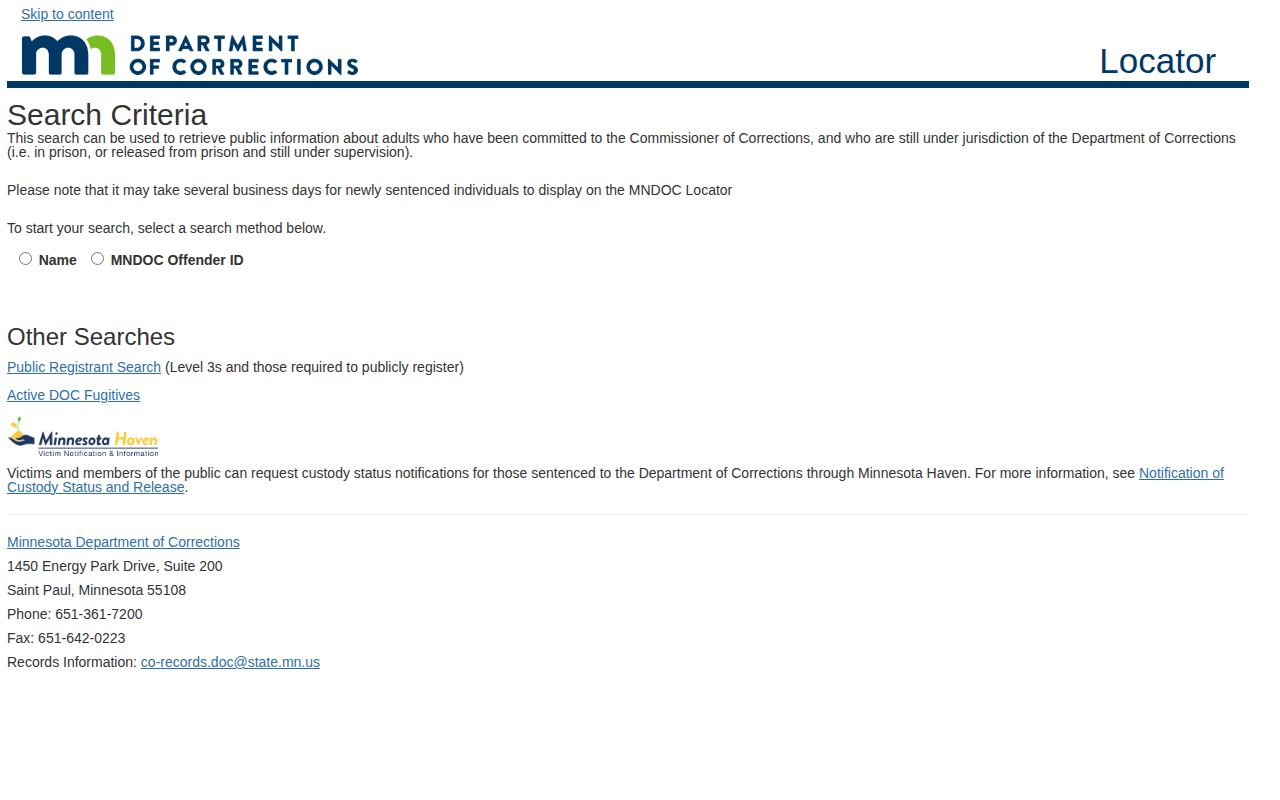
The captured Locator reinforces a key limit: the search serves people still under DOC jurisdiction, including released people on supervision, and is not a permanent archive after final discharge.
The Cook County released-inmate records path provides broader custody and transfer checks when the current facility is uncertain.
Note: A date on a court docket may describe sentencing, expiration, or eligibility rather than the physical release date.
Cook County Jail Date Calculations
A local jail sentence starts with the signed sentencing order. The calculation can require the sentence start date, credit for days already served, whether multiple terms are concurrent or consecutive, and any locally applicable diminution under Minnesota Statutes section 641.12. Diminution is a lawful reduction in the jail term under the rule that applies. It must be confirmed with the jail rather than assumed.
Cook County’s setup makes custody location critical. A person eligible for the Work Release/Huber unit may serve locally and leave for authorized work while still legally confined. Another person serving less than a year may be housed by a contract county because work release is unavailable. Cook County remains tied to the case, but the receiving custodian may maintain the day-to-day release calculation.
Do not apply a state-prison two-thirds formula to a local misdemeanor or gross-misdemeanor jail sentence. Also, seeing a Huber participant outside the secure area is not proof of discharge. The final local record should state when custody ended and whether Cook County released the person to the community or another authority.
Minnesota Prison Release Credit
For a modern executed Minnesota felony sentence, section 244.101 generally describes two-thirds as the minimum imprisonment term and one-third as the maximum supervised-release term, subject to release law. That baseline is about 66.7 percent. Minnesota should not be described as requiring the federal-style 85 percent shorthand for this sentence model.
The Minnesota Rehabilitation and Reinvestment Act adds earned incentive release credit for eligible cases. Under section 244.44, qualifying credit can total up to 17 percent of the full executed sentence, cannot reduce imprisonment below one-half, and can be revoked for a facility-rule violation or criminal act while incarcerated. Section 244.45 excludes life sentences, certain indeterminate sentences, and people governed by older good-time law.
Earned compliance credit under section 244.46 is different. It concerns active community supervision and possible abatement after prison release. It should not be subtracted from the prison-door date. The total sentence, supervised-release term, and final discharge still require the exact DOC calculation.
Why Cook County Release Dates Change
A current estimate can move for legal, factual, and administrative reasons. Some changes shorten the custody term. Others delay community release or move the person to a new custodian. Ask for the updated source record rather than trying to recalculate from a roster date.
| Factor | Possible effect | Record to check |
|---|---|---|
| Corrected jail credit | Changes time already credited against the sentence. | Amended judgment and custodian calculation. |
| Concurrent or consecutive term | Changes whether terms overlap or run in sequence. | Sentencing order and DOC sentence record. |
| Earned credit or discipline | May advance a date or revoke credit. | MNDOC calculation and discipline decision. |
| Resentencing or appeal | Can alter the term or credit award. | Newest signed court order. |
| Conditional-release term | Adds an offense-specific framework. | Judgment, statute, and DOC record. |
| Detainer or new case | May send the person to another authority. | Custody-event log and receiving record. |
| Release plan or Board action | Can assign, delay, deny, or rescind a date. | DOC file, Board minutes, and order. |
A detainer is a request or legal basis for another authority to assume custody. It can mean the first agency records a release even though the person does not return to the community. Check the receiving agency separately.
Cook County Board Release Dates
The Minnesota Supervised Release Board reviews only designated sentence categories. It is not the decision-maker for every ordinary determinate term. Its official process covers certified adults, life or indeterminate cases, and specified criminal-sexual-conduct sentences.
The Board says an initial readiness review takes place three years before the minimum parole-eligibility date. That review is not the day of release. No statute lets the Board release a person before the minimum. A later action may assign a projected date, continue the matter, deny it with directions, set another review, rescind a grant, or address revocation.
Use the dated Board Review Schedule, current agenda, approved minutes, and individual order. Meeting materials remain posted for about 90 days, so older results can require a records request. Quote the exact outcome.
Cook County 72-Hour Rule
Cook County’s phrase “72 hours excluding weekends and holidays” describes its local holding function for first-appearance and pretrial detainees. It is not a sentence credit, a promised release hour, or a public three-day release list. Minnesota DOC’s inspection separately classifies the jail as a 72 Hour Holding facility.
This local limit must stay separate from chapter 244 state-prison calculations and section 641.12 local sentence diminution. A detainee can move to another county when Cook’s short local holding role ends. That is continued custody, not sentence completion. Ask for the movement log and receiving agency before describing it as release.
Note: Weekends and holidays affect the stated local holding limit, but Cook County publishes no fixed release-processing schedule.
Confirm Cook County Actual Release
Close to the projected date, verify with the agency that physically holds the person. For Cook County custody, ask whether the event is community release or transfer and request the movement timestamp. For a state sentence, read the current MNDOC status and contact Records Management when the public result lacks the needed field. A finally discharged person may no longer appear because the Locator covers continuing DOC jurisdiction.
Register for a specific-person update through the Minnesota VINELink release check for participating county jail custody. A VINE event is useful, but “released” can mean the jail gave custody to another authority. DOC-sentenced cases use Minnesota Haven for conditional or final release and sentence-expiration notices.
After the expected day, compare the court authority, the custodian’s timestamped event, and the receiving agency, if any. Record when each source was checked. This avoids turning an older estimate into a false statement of present custody.
If no current public result appears, do not work backward from a projected date and call it final discharge. The person may never have entered DOC, may have completed all DOC jurisdiction, may be listed under a different conviction-associated name, or may belong to a county, federal, or immigration custody system. MNDOC Records Management accepts requests by phone at 651-361-7330, fax at 612-473-5006, and email at CO-Records.DOC@state.mn.us. A narrow request should include the OID and ask for the public sentence, release, supervision, and discharge dates that the agency maintains.
For an older local sentence, request the Cook County booking sheet, custody or movement log, sentence-credit calculation if maintained and public, date and time Cook relinquished custody, release or movement code, and receiving agency. That set of existing records can distinguish sentence completion from transfer. The Sheriff accepts requests in person, by phone, mail, email, and through the county online form. Inspection is free. Cook County does not charge when copy cost is under $10, while most other copies can be billed at the actual cost allowed by its policy. The county promises a response as soon as reasonably possible, not a fixed ordinary turnaround. State the booking date range and ask for electronic data in its native format when kept that way.
Federal and immigration dates also require their own systems. A BOP release date speaks only to federal prison custody, and “Not in BOP custody” does not rule out USMS, state, local, or ICE custody. ICE’s locator addresses immigration detention, not a Cook County jail sentence. Never copy one agency’s date into another agency’s record without confirming the transfer path.
Public Record Search
Sponsored Results