
Cook County Three-Day Release Window
The Cook County Sheriff’s official Jail Roster page offered one dated roster PDF when checked. It did not offer a 72-hour released-person tab, a three-day download, or an archive of prior rosters. No official feed URL, field set, update cycle, or retention period exists to report. The correct answer is the absence of a feed plus a documented records path.
A three-day review is still possible for one known person. It requires several sources because each answers a different question. The roster can establish presence at a report time. Minnesota VINE may report a custody event. A court entry can explain the legal action. The Sheriff’s custody-event log can show when Cook County relinquished custody, the movement code, and the receiving agency when public.
Review Cook County 72-Hour Releases
Set a clear start and end time before searching. Preserve the report time on each record, not just the day printed on a file. A weekend period can span court activity, jail processing, and transfer events that occur at different times. Use the same legal name, date information, booking number, and case number across all sources to avoid merging two people.
- Open the stable Cook County roster page and note the timestamp on the current linked PDF.
- Search Minnesota VINE for the specific person and read both the custody wording and supplying agency.
- Call 218-387-3030 and ask whether Cook County relinquished custody during the selected period.
- Review the newest Cook County case entry in Minnesota Court Records Online for the order or disposition that may explain the move.
- Submit a chapter 13 request for the booking sheet and custody, movement, release, or transfer entries covering the date range.
- If another custodian received the person, continue with that jail, Minnesota DOC, BOP, or ICE source.
For a same-day question, the Cook County 24-hour release process narrows the time span. A longer window should not dilute the proof standard. The agency record remains stronger than an inferred difference between dated rosters.
Note: Ask for existing custody records within a date range rather than asking county staff to create a new three-day list.
Cook County Three-Day Record Fields
No public Cook County 72-hour feed means there is no official feed field inventory. The useful fields come from the underlying Sheriff record. Request enough detail to tell a community release from a transfer, but expect lawful redactions for protected data. The response may use an agency event code rather than plain-language wording.
| Requested field | Use in a three-day review |
|---|---|
| Full name, aliases, booking number | Confirms that all entries refer to the same Cook County booking. |
| Booked date and time | Sets the local custody period and search range. |
| Roster or report timestamp | Shows when the public snapshot was generated, not when release occurred. |
| Custody exit date and time | Places the physical movement inside or outside the selected 72-hour period. |
| Release or movement reason | Separates bond, court order, time served, transfer, and other recorded outcomes. |
| Receiving agency or facility | Directs the next search when confinement continued elsewhere. |
| Court file and hold status | Connects custody to the controlling case and any other agency hold. |
The official record can be narrower than the requester expects. Minnesota law does not make every detention field public. Active investigative, juvenile, sealed, expunged, medical, security, and other protected data may be withheld. Request the statutory basis for any denial and ask for the rest of the segregable public data.
Cook County’s public-data channels include an online public-data form as well as in-person, telephone, mail, and email requests through Sheriff Records. State that the request seeks public data under Minnesota chapter 13. Identify the date range and ask for electronic copies in their native form when the county keeps them that way. That wording seeks existing data and avoids asking staff to build a custom release report.
Cook County Weekend Release Timing
Cook County states that its local first-appearance and pretrial holding can last up to 72 hours excluding weekends and holidays. That rule describes the facility’s holding function. It is not a weekend release schedule, a public list duration, or a promise that a roster name remains visible for three days. The distinction is vital because the same phrase appears in two very different contexts.
A weekend can also delay when separate pieces of evidence become visible. Court action, transport, and jail processing do not share one timestamp. A person may have a filed order while physical release or transfer is still being processed. Conversely, a roster PDF may remain online after custody changes because no refresh cadence is published.
Record each source’s “as of” time. If the date range includes a holiday, confirm office access and filing availability before travel. Sheriff Records accepts requests through several channels, but that does not promise immediate fulfillment at all hours.
Cook County Roster Archive Gap
The roster’s single-document architecture makes a multi-day search harder than a same-day check. A dated file can be replaced, and the landing page does not promise access to prior versions. Unless a person saved an earlier official PDF, the public page may not provide both endpoints needed for a comparison.
Even when two official snapshots are available, the difference between them is not a release reason. A name can leave Cook County’s list after transfer to another county, delivery to the Minnesota DOC, a writ or court movement, hospitalization, another agency’s hold, or a true release. A transfer log may be more probative than a record labeled “release.”
See the current Cook County roster source before reviewing its official capture.
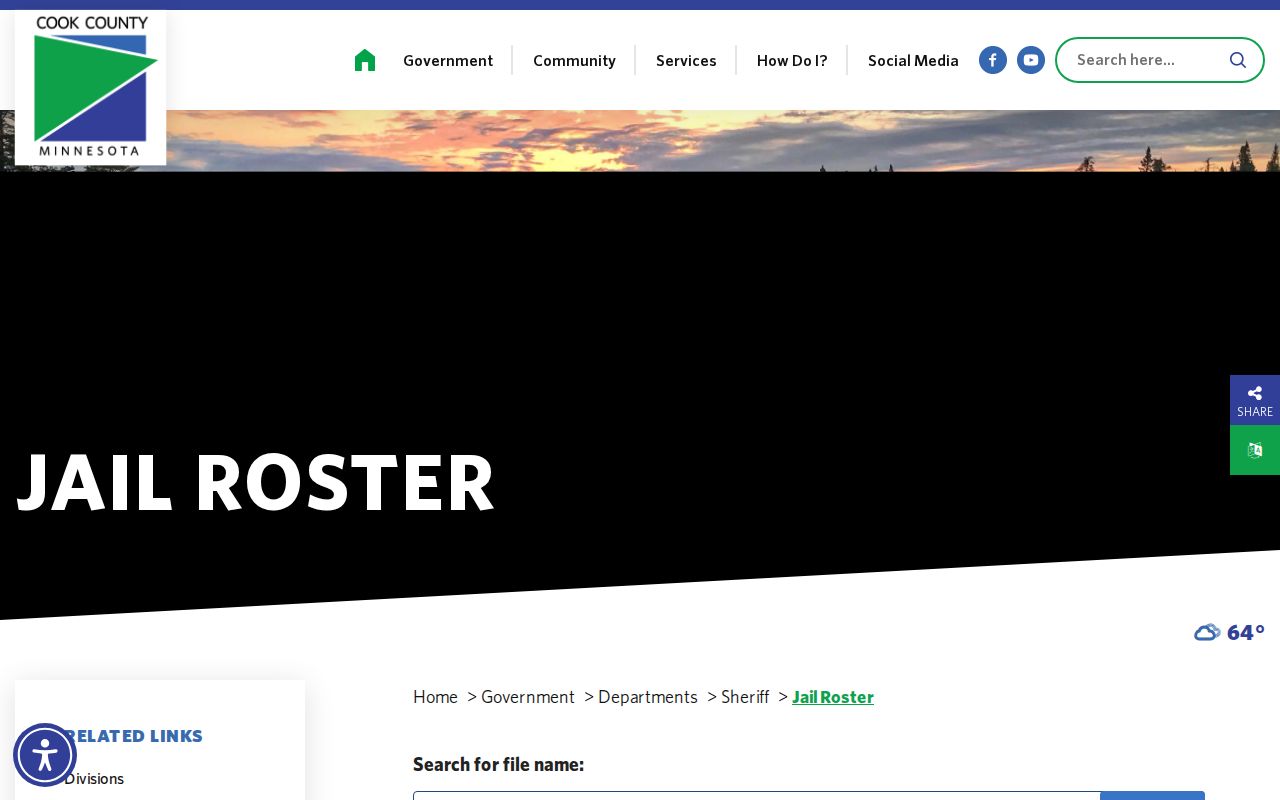
The capture shows a roster landing page built around a current dated document, which is why a formal record request is the durable route for an earlier custody event.
Note: Never publish a scraped difference between Cook County roster PDFs as though the Sheriff issued a release list.
Cook County Release Destination Check
Cook County’s detention model is small and fragmented. The local jail handles short holding, while longer-term pretrial detainees and some people serving shorter sentences may be housed by another county. The county does not publish one fixed contract jail. A case can remain a Cook County court matter even though the person is held elsewhere and appears for court by video.
| Recorded outcome | Next official source |
|---|---|
| Community release from local jail | Cook County custody record plus the court order or sentence entry. |
| Receiving county transfer | Named receiving jail and Minnesota VINE. |
| Minnesota DOC commitment | MNDOC Locator by name or six-digit offender ID. |
| Federal custody | BOP locator for committed federal prisoners, or the responsible federal custodian for other cases. |
| Immigration custody | ICE Online Detainee Locator, searched separately from the county record. |
A Minnesota DOC result applies only to adults committed to the Commissioner who remain under DOC jurisdiction. It is not the next stop for every person leaving the Cook County roster. Likewise, “released” from one agency does not prove that no other custodian took control.
Cook County Three-Day Fallback Chain
When the current roster cannot answer a past three-day question, call the Law Enforcement Center and follow with a narrow public-data request. Identify the person, aliases if known, the booking or date range, and the records sought. Ask for booking, custody-event, release or transfer time, movement code, destination, and receiving agency data. The county’s online public-data form is the preferred web entry point.
Use Minnesota VINE as a person-specific alert and event layer. Use MCRO for the legal case and its newest order or disposition. If a state prison commitment appears, search the MNDOC Locator. Each tool has a defined scope. None turns the Cook County roster into a rolling release archive.
For an older or completed period, MCRO is often the durable index for the underlying Cook County prosecution. The court record may show a bond order, sentence, warrant, or later disposition. It may not show the physical custody timestamp. Reconcile it with Cook County’s movement data, and request the receiving jail’s release data if another county actually held the person at the end of the three-day span.
When the task is to identify one named person across all custody layers, use the Cook County released inmate search alongside this time-window review.
- Current roster
- A snapshot of listed custody at its report time.
- VINE event
- An agency-supplied custody change used for notification and corroboration.
- Court entry
- The legal order or disposition, which may not show the physical exit time.
- Custody log
- The holding agency’s timestamped physical movement record.
Public Record Search
Sponsored Results