
Cook County Mugshots and Records
A booking photograph records appearance during processing into custody. It does not prove guilt, and release does not explain how the charge ended. Minnesota Statutes section 13.82 generally treats a booking photograph as public law-enforcement data unless access would adversely affect an active investigation. Other lawful limits can still apply to related data.
The photo remains tied to that booking after a person leaves Cook County custody. Yet public does not mean permanently displayed online. Cook County offers a dated current-roster PDF through a Document Center, not a historical released-person photo archive. When that document changes, a former detainee’s entry may vanish even though Sheriff Records still maintains responsive booking data.
A county booking photo is also distinct from an MNDOC correctional image. If a Cook County case later leads to state prison, the state image comes from a different agency and event. The supplying agency, image date, and record type should stay attached to every identification.
For release status and the underlying movement record, use the Cook County released-inmate search instead of treating a photograph as proof of present custody.
Cook County Released Mugshot Channels
No single official source covers every Cook County released inmate mugshot. The correct channel depends on whether the person was booked locally, committed to state corrections, or pictured in a public report. Current custody tools can provide leads, but an old booking-specific request is the durable route.
| Channel | Has a photo? | How to access |
|---|---|---|
| Cook County roster PDF | Must be checked on the current dated document; the landing page does not promise photos. | Open the stable Sheriff roster page and inspect the live PDF. |
| Sheriff Records | A booking-specific image can be requested, subject to lawful limits. | Use the county public-data form with the booking date and number. |
| MNDOC Locator | Some public DOC results within scope may display a corrections image. | Search by name or six-digit OID and identify the image as DOC, not county. |
| Public Registrant Search | May show an image only for disclosure-eligible registrants. | Use the official limited registry, never as a general gallery. |
| Minnesota VINE | Interface content can vary; it is a custody-alert system, not an archive. | Search one person and verify the supplying agency. |
| Local reporting or official social posts | Sometimes, when an agency or publisher included one. | Attribute and date the image, then verify present status officially. |
| Commercial copies | May contain stale or mismatched material. | Treat only as a lead and verify against the originating record. |
The official Cook County Sheriff Records page documents the available request routes.
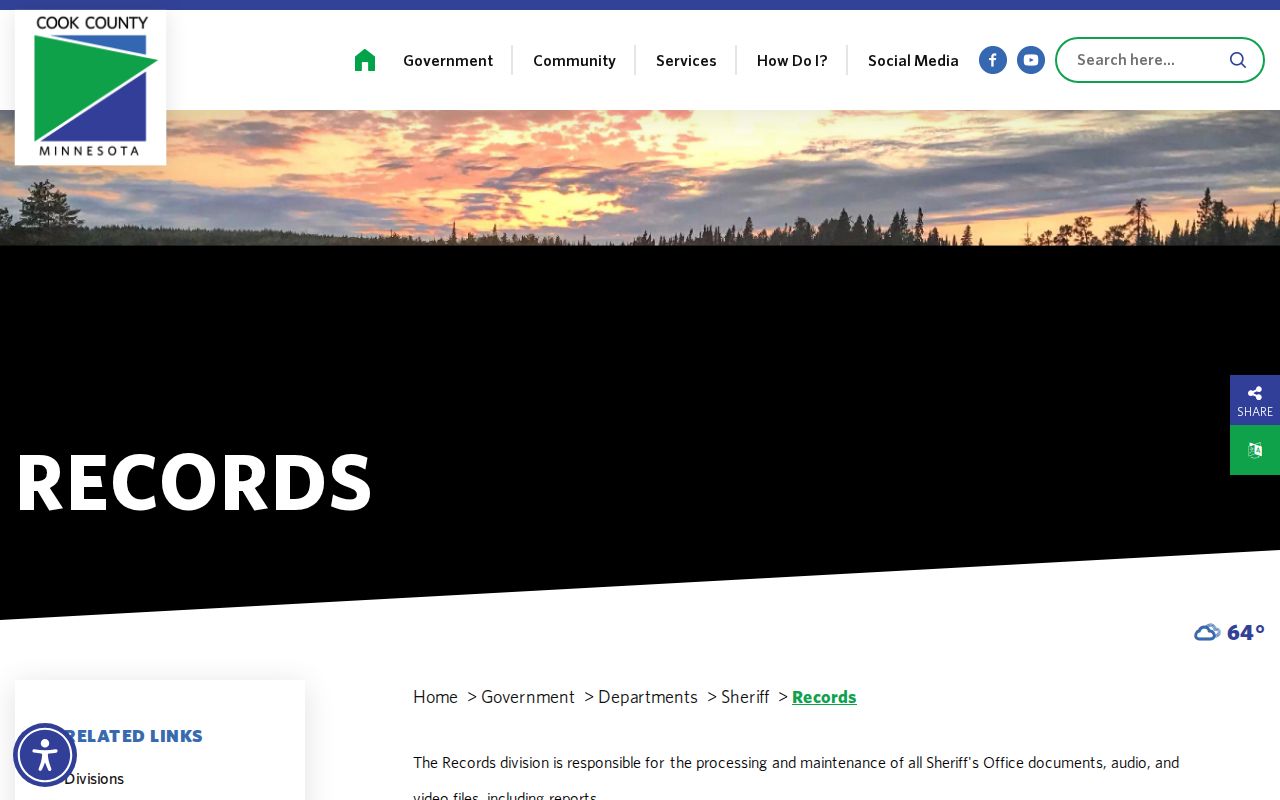
This capture points to the agency channel that maintains Sheriff reports and booking-photo requests after a current roster entry is gone.
Cook County Roster Photo Limits
The Cook County Jail Roster landing page held one dated PDF when researched. It was not labeled as a release list, booking archive, or photo gallery. The page states no refresh time and no retention period. A reader must visually inspect the current PDF to see whether photographs render and note its report timestamp.
The Cook County 24-Hour Release List explains the no-feed result and the person-specific fallback when the goal is to verify a recent exit rather than locate an image.
Sequential absence is weak proof. A name or image can disappear because the report changed, the person transferred, or Cook County relinquished custody. That absence does not state the movement code, destination, or outcome. The current roster serves people still listed at report time, while the Sheriff custody log and photo request serve the historical question.
No Cook County Sheriff jail-information app was identified. The county links an official Sheriff Facebook page, but no systematic booking-photo or released-person series was found there. Minnesota VINE offers mobile access and alerts statewide. It is not a Cook County booking-photo archive and should not be described as a Sheriff app.
Note: The county’s one-document roster design creates an online archive gap; it does not prove that the underlying booking image was destroyed.
Request Cook County Booking Photos
A narrow request gives Sheriff Records the best chance to locate the right image. Include the exact booking when known. Do not ask the county to research a broad question or create a new report. Chapter 13 permits access to existing public data and allows the agency to redact or withhold parts under a cited classification.
- Confirm the legal name, useful aliases, booking date range, and booking number if available. Add a court file number when it helps distinguish the person.
- Open the Cook County Public Data Request form or use the in-person, phone, mail, or email route described by Sheriff Records.
- Ask for “the booking photograph from the [date] booking” as a separate item. Also request the booking sheet when the image must be tied to an event.
- State that the request is for existing public data under Minnesota Statutes chapter 13. Ask for an electronic copy in native form if the county keeps it that way.
- If access is denied or part is redacted, ask for the statutory basis and for all segregable public portions. Section 13.82 allows temporary withholding when access would adversely affect an active investigation.
Inspection is free. Cook County states that copy costs under $10 are not charged. For 100 or fewer letter or legal black-and-white pages, the policy lists 25 cents per one-sided page and 50 cents per two-sided page. Other copies may carry actual cost, including outside-vendor photograph cost. Prepayment can be required, and no fixed ordinary response deadline is promised beyond production as soon as reasonably possible.
Requests may be directed to Cook County Sheriff’s Office Records, 143 Gunflint Trail, Grand Marais, MN 55604, phone 218-387-3030, fax 218-387-3032. The online form and Records page are the safer evergreen channels when personnel change.
Cook County DOC Photo Differences
The MNDOC Locator covers adults committed to the Commissioner who remain under DOC jurisdiction, either in prison or released while still supervised. Someone whose custody ended only at Cook County Jail may never appear. A person who reached final discharge may also fall outside the Locator’s declared population.
Search by first and last name or six-digit OID. Name matching begins with the letters typed and can include conviction-associated, former, and AKA names. Open the correct result, confirm the OID, and preserve the agency label. If a photograph appears, call it a DOC correctional image unless the record itself says otherwise.
The Minnesota Public Registrant Search is narrower. It covers people subject to specified registration and public-disclosure rules. It is not a list of all released Cook County inmates. The separate noncompliant registry also has a limited purpose. Neither should be used to infer that a person with no result lacks a past booking photo.
Cook County Photos Beyond Agencies
Commercial roster and mugshot pages surfaced during research, but they can confuse Cook County, Minnesota with Cook County, Illinois, repeat old entries, and infer update schedules that the Sheriff never published. No commercial source is linked or endorsed. If such a copy supplies a lead, confirm the name, county, booking date, image source, and case through official records.
Local reporting from WTIP or the Cook County News Herald may preserve an arrest image and context after a roster changes. Sheriff releases or official social posts can do the same. These are published reports, not live custody indicators. Attribute the outlet, keep its publication date, respect copyright, and check the present status with the custodian.
Old publication can outlast the official display. That persistence does not change the underlying legal result. Charges may later be dismissed, a sentence may end, or a court may issue an expungement order. Pair any historical image with the official disposition rather than letting the photograph stand in for the case.
Cook County Historical Mugshot Policy
Cook County does not promise a historical mugshot gallery. Its stable roster landing page links a dated PDF, and the document must be checked for current photo inclusion. No archive, replacement cycle, or released-person retention period is stated. That is why an agency request tied to one booking is more durable than searching successive PDFs.
Section 13.82 supplies the principal booking-photo rule. Access may be delayed if release would harm an active investigation, and other classifications can affect related material. Ask the Sheriff to cite the legal basis for any denial and to release separable public data. The fact that an image is public does not guarantee that every connected field is public.
Cook County Mugshot Corrections
Minnesota chapter 609A governs criminal-record expungement. An order can seal records held by identified agencies, but it does not guarantee deletion of every copy previously sent elsewhere, every news report, or every federal or tribal record. Use current Judicial Branch forms and the Cook County case rather than assuming that one outcome covers all images.
No current Minnesota law was verified that creates a general anti-pay-to-remove mugshot right like statutes in some states. Do not claim one. Correction, removal, copyright, and reputational questions depend on who holds the image and why. An official correction request should identify the exact record, the error, and the order or source that supports the change.
For an official Cook County image, begin with Sheriff Records and the county’s responsible authority. For a court restriction, obtain the signed order and confirm which agencies it reaches. For news or other publishers, use that publisher’s correction process. Avoid services that promise a universal deletion, since no single party controls every copy.
When identity is the problem, include enough booking detail to show the mismatch without spreading protected data. A same-name error can be resolved by comparing booking number, booking date, arresting agency, court file, and the source agency’s own caption. Ask the source to correct inaccurate government data through its responsible authority. Keep the response, because the change may not flow automatically to every earlier recipient.
Note: Sealing can restrict official access, while an old lawful publication may require a separate source-specific correction or removal request.
Public Record Search
Sponsored Results